

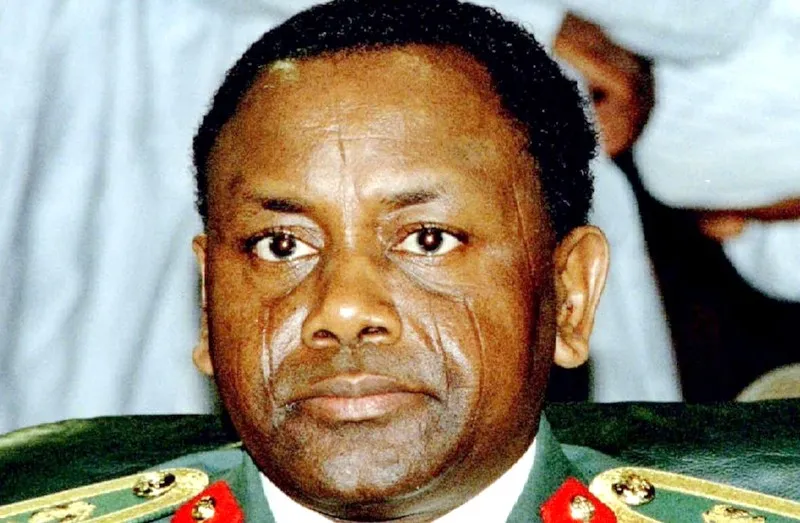
To understand Abacha fully, it is important to examine his upbringing, military career, role in Nigeria’s coups, domestic and foreign policies, relationship with pro-democracy activists, personal life, death and continuing legacy.
Who was Sani Abacha?
20 September 1943 – 8 June 1998

-
Full name: Sani Abacha
-
Nationality: Nigerian
-
Ethnic background: Kanuri
-
Religion: Islam
-
Birthplace: Kano, Northern Nigeria
-
Occupation: Soldier and military ruler
-
Position: Head of State and Commander-in-Chief of the Armed Forces
-
Time in power: 17 November 1993 – 8 June 1998
Abacha rose through the ranks of the Nigerian Army during a period when military coups repeatedly changed the country’s political leadership. He participated in several coups and became one of the most influential officers in Nigeria.
He assumed power after the removal of the interim civilian government led by Chief Ernest Shonekan in November 1993. His government ruled by military decrees rather than through an elected national government.
Abacha died in office in 1998, before completing his proposed transition to civilian rule.
2. Early life and family background
Sani Abacha was born on 20 September 1943 in Kano, in what was then Northern Nigeria, under British colonial rule.
He came from the Kanuri ethnic group, whose historic homeland includes parts of present-day Borno State and the Lake Chad region. His upbringing took place in northern Nigeria during the final years of colonial rule and the approach of independence.
Nigeria became independent on 1 October 1960, when Abacha was approximately 17 years old.
Details of his early childhood and family life are less extensively documented in widely available public records than his military career. His later rise was primarily associated with his professional military service and relationships within the armed forces.
3. Education and military training
Abacha joined the Nigerian Army in the early 1960s, beginning a career that would eventually place him at the centre of national politics.
He received military training in Nigeria and undertook professional military courses, including training associated with military institutions in the United Kingdom.
His career developed during Nigeria’s first decade of independence, when the armed forces became increasingly involved in national politics.
The January 1966 coup ended Nigeria’s First Republic, and the July 1966 counter-coup further entrenched military influence. The Nigerian Civil War, fought from 1967 to 1970, provided another important setting for the advancement of military officers of Abacha’s generation.
Abacha progressed through command and staff positions, building a reputation as a career soldier who would later become a central figure in successive military governments.
4. Sani Abacha’s military career

Abacha’s military career spanned more than three decades. His advancement coincided with Nigeria’s civil war, repeated military coups and the establishment of military governments.
Key stages of his career
-
1963: Commissioned as a second lieutenant in the Nigerian Army.
-
1967–1970: Served during the Nigerian Civil War, also known as the Biafran War.
-
1983: Became a senior figure in the military government established after the coup that removed President Shehu Shagari.
-
1985: Played a prominent role in the coup that brought General Ibrahim Babangida to power.
-
1985–1990: Served as Chief of Army Staff under Babangida.
-
1989: Became Chairman of the Joint Chiefs of Staff.
-
1990: Became Minister of Defence.
-
1993: Became the country’s Head of State after removing Ernest Shonekan’s interim government.
Nigeria’s Defence Headquarters confirms his service as Chief of Defence Staff from December 1989 to September 1993, followed by his appointment as Defence Minister.
His role in Nigeria’s coups
Abacha was associated with the military interventions that shaped Nigeria’s political history in 1983 and 1985.
In December 1983, the military overthrew the elected government of President Shehu Shagari, bringing Major-General Muhammadu Buhari to power. Abacha subsequently held senior military positions.
In August 1985, Babangida overthrew Buhari. Abacha played a prominent role in announcing the coup and subsequently became Chief of Army Staff.
He remained influential throughout Babangida’s administration, including during the failed coup attempt led by Major Gideon Orkar in April 1990.
His experience, military connections and senior positions helped establish him as one of the country’s most powerful officers before he took over the government in 1993.
5. How Sani Abacha became Head of State in 1993
Abacha’s rise to the presidency cannot be separated from the political crisis surrounding Nigeria’s disputed 12 June 1993 presidential election.
The annulment of the June 12 election
On 12 June 1993, Nigeria held a presidential election widely regarded as a significant moment in its democratic history. Businessman and Social Democratic Party candidate Moshood Kashimawo Olawale Abiola, popularly known as MKO Abiola, was widely believed to have won.
The election was annulled by the military government of Ibrahim Babangida before the results could be fully consolidated and officially declared.
The annulment provoked widespread anger, protests and political unrest. Many Nigerians considered the election a credible expression of the electorate’s choice, and its cancellation became a defining event in the country’s struggle for democratic government.
Ernest Shonekan’s interim government
Babangida stepped aside on 26 August 1993 and handed power to an Interim National Government headed by Chief Ernest Shonekan.
The arrangement was intended to manage the political crisis and prepare the country for a return to civilian government. However, the interim administration faced challenges over its legitimacy and authority.
The November 1993 takeover
On 17 November 1993, Abacha removed Shonekan from power and assumed control of the government.
His takeover ended the interim administration and returned Nigeria to direct military rule. Abacha became Head of State and Commander-in-Chief of the Armed Forces.
His government subsequently dissolved or suspended important democratic institutions and relied on military decrees to govern the country.
This takeover marked the beginning of a period in which opposition groups, journalists, activists and supporters of the June 12 election faced increasingly severe restrictions.
6. Sani Abacha’s government and leadership style
Abacha’s administration was highly centralised, with political and executive authority concentrated in the military leadership.
Unlike an elected president operating under a functioning democratic constitution and legislature, Abacha governed through military decrees and a ruling council.
His government restricted political competition, controlled public demonstrations and took measures against people considered threats to its authority.
The United States Department of State’s report on Nigeria’s 1998 human rights record described systematic abuses during Abacha’s period in power and noted that Nigerians did not have the right to change their government through elections.
Political parties and democratic institutions
Abacha initially presented his administration as a means of restoring stability and eventually returning Nigeria to civilian rule.
However, his government tightly controlled the transition process. Political activities remained restricted, and the administration retained decisive influence over the institutions and arrangements intended to lead to civilian government.
In 1995, the government announced a new constitution and continued to organise a transition programme. But opposition groups questioned the credibility of the process, particularly amid arrests, intimidation and the exclusion of genuine political competition.
Was Abacha planning to remain in power?
The transition programme became a major source of controversy in the final years of his government.
In 1998, political organisations associated with the transition process endorsed Abacha as their preferred presidential candidate. The development raised widespread concerns that a process presented as a route back to civilian rule was being used to extend his leadership.
Abacha died before the proposed civilian transition was completed.
His successor, General Abdulsalami Abubakar, introduced a different transition programme that led to elections and the restoration of civilian government on 29 May 1999.
7. Human rights abuses under Abacha


Human rights abuses are among the most extensively documented aspects of Abacha’s rule.
Human rights organisations reported arbitrary arrests, detention without trial, restrictions on freedom of expression, intimidation of political opponents and the use of security forces against perceived opponents of the government.
Amnesty International described the situation in 1994 as a major human rights crisis. It documented the detention of people for their peaceful political views and activities, including Moshood Abiola and environmental activist Ken Saro-Wiwa.
The arrest and detention of MKO Abiola
Following the annulment of the June 12 election, Abiola continued to demand recognition of his presumed electoral victory.
In June 1994, he declared himself the rightful president of Nigeria. The Abacha government arrested him and charged him with treason.
He remained in detention for several years and was denied the opportunity to assume the presidency he claimed to have won.
Abiola died on 7 July 1998, almost one month after Abacha’s death. His death occurred shortly before he was expected to be released following discussions with the new military government.
His death became another defining event in Nigeria’s democratic history. The June 12 election and Abiola’s struggle subsequently became central symbols of the campaign for democratic restoration.
The execution of Ken Saro-Wiwa and eight Ogoni activists
One of the most internationally condemned events during Abacha’s presidency occurred on 10 November 1995.
Ken Saro-Wiwa, a writer and environmental activist, and eight other Ogoni men were executed after being convicted by a special tribunal over the deaths of four Ogoni leaders.
Saro-Wiwa was a prominent campaigner for the rights of the Ogoni people in the Niger Delta. His Movement for the Survival of the Ogoni People (MOSOP) opposed environmental degradation and demanded greater accountability and benefits for oil-producing communities.
The activists’ trial attracted widespread criticism from international observers and human rights organisations, which raised concerns about the fairness of the proceedings.
Amnesty International condemned the executions and documented concerns over the trial and death sentences.
The executions damaged Nigeria’s international reputation and intensified calls for sanctions and diplomatic pressure.
Crackdown on journalists and the media
Journalists and media organisations also faced pressure during Abacha’s government.
Authorities restricted publications, detained journalists and took action against media outlets that reported critically on the administration.
The broader climate of intimidation made independent reporting and public criticism more difficult. Some journalists and activists left Nigeria or continued their work from abroad.
The restrictions affected public debate on government accountability, human rights and the June 12 election.
Other political opponents
Abacha’s government also pursued political figures, activists and officers accused of plotting against it.
In 1995, former military ruler Olusegun Obasanjo was arrested and convicted in connection with an alleged coup plot. He remained in prison until Abacha’s death and was released by the succeeding government.
The government’s treatment of alleged opponents reinforced concerns about due process, political freedoms and the role of the military in civilian affairs.
Overall, the human rights record of the Abacha administration remains a central part of how historians and human rights organisations assess his rule.
8. Sani Abacha and the Nigerian economy
Abacha’s economic record is complex. His government made policy changes, funded some public projects and maintained control over the oil-dependent economy. However, allegations of large-scale corruption and the diversion of public funds became central to his legacy.
Oil and government revenue
Oil was the main source of Nigeria’s foreign exchange earnings and a major source of government revenue during Abacha’s administration.
The government controlled important aspects of the economy, including foreign exchange policy, public spending and the management of state-owned enterprises.
Economic performance was influenced by international oil prices, government policies and structural weaknesses that had developed over previous decades.
The Petroleum Trust Fund (PTF)
One of the best-known initiatives associated with Abacha’s government was the Petroleum Trust Fund, established in 1994 and operational from 1995.
The fund used revenue associated with petroleum pricing to finance public projects, including roads, health facilities, educational infrastructure and other services.
The PTF was headed by retired Major-General Muhammadu Buhari, who later became Nigeria’s elected president.
The fund was credited with supporting infrastructure and public-service projects, although the overall economic and political record of Abacha’s administration remained contested.
Economic policy changes
Abacha’s government initially introduced tighter controls over economic activity but later moved towards what it called guided deregulation.
According to a US government economic report, the administration’s 1995 budget reopened the Autonomous Foreign Exchange Market, relaxed some restrictions on foreign investment and reduced certain import tariffs and bans.
However, Nigeria continued to face problems involving public-sector inefficiency, inadequate infrastructure, unemployment and dependence on crude oil.
Was the economy better under Abacha?
This question requires examining individual indicators rather than relying on political claims.
Foreign exchange reserves, inflation, public expenditure, economic growth and household living standards do not necessarily move in the same direction. Moreover, changes in oil prices can significantly affect national economic figures.
The period also became associated with allegations that enormous sums of public money had been diverted into foreign accounts. Therefore, improvements in some economic indicators would not, by themselves, establish that the benefits were widely shared or that public resources were properly managed.
9. The Abacha loot scandal

The Abacha loot scandal is one of the most prominent international cases involving the recovery of assets allegedly stolen from a country’s public treasury.
After Abacha died, Nigerian and foreign investigators traced funds connected to his administration and family to bank accounts and assets in several jurisdictions.
Investigations and legal proceedings led to the freezing, confiscation and repatriation of substantial sums.
How much money was stolen?
There is no single figure that captures every allegation, investigation, confiscation and recovery associated with Abacha.
Estimates of the total amount diverted during his rule vary. The Nigerian Dictionary of National Biography cites estimates of between US$3 billion and US$5 billion, while individual recovery cases concern specific amounts and jurisdictions.
It is important to distinguish between money alleged to have been stolen, money traced or frozen, money legally confiscated and money actually returned to Nigeria.
Major asset recovery cases
$226.4m
Approximately
Liechtenstein — 2014
Nigeria received approximately US$226.4 million in Abacha-related assets following confiscation proceedings. The recovery involved cooperation between Nigerian and Liechtenstein authorities, with monitoring by the World Bank.
$321m
Approximately
Switzerland and Luxembourg — 2017
Nigeria, Switzerland and the World Bank agreed on the return and monitoring of approximately US$321 million in assets connected to the Abacha family. The funds were earmarked for targeted cash transfers to poor and vulnerable Nigerians through a social safety-net programme.
These figures relate to specific cases and should not simply be added together without checking for differences in case scope, currency conversion and possible overlap.
Why did the recovery take so long?
The process involved several challenges:
-
Tracing funds across international banking systems.
-
Establishing links between assets and alleged criminal activity.
-
Obtaining court orders in foreign jurisdictions.
-
Resolving appeals and competing legal claims.
-
Negotiating agreements for returning and monitoring recovered funds.
The case demonstrated how corruption investigations can require cooperation among multiple countries over many years.
What happened to the recovered money?
The arrangements varied by recovery. In the 2017 Swiss agreement, the Nigerian Government agreed that the funds would support targeted cash transfers to vulnerable people under the National Social Safety Net Project, with World Bank monitoring and civil-society involvement.
The wider lesson is that recovering stolen assets is only one stage of accountability. Transparency in how the returned funds are spent is also essential.
10. Nigeria’s international relations under Abacha

Abacha’s human rights record and refusal to restore democratic government damaged Nigeria’s relationships with several international partners.
Suspension from the Commonwealth
On 11 November 1995, the Commonwealth suspended Nigeria following the execution of Ken Saro-Wiwa and eight other Ogoni activists.
The decision reflected concerns about human rights, due process and the continuation of military rule.
Nigeria remained suspended until 1999, when the Commonwealth lifted the suspension following the transition to elected civilian government.
Relations with Western countries
The executions and continued repression attracted condemnation from governments, human rights organisations and international campaigners.
Nigeria faced diplomatic pressure and restrictions from some countries. The country’s international image suffered, particularly because the government proceeded with the executions despite appeals for clemency.
Relations with African countries
Nigeria remained an important African state because of its population, oil resources, military capacity and diplomatic role.
Nevertheless, the Abacha government’s political isolation complicated its international standing. Its domestic policies became a significant issue in discussions about democratic governance and human rights across Africa.
11. Sani Abacha’s family and personal life

Abacha was married to Maryam Abacha. Biographical accounts report that they married in 1965 and had nine children: six sons and three daughters.
His family became the subject of international attention after his death because of investigations into assets allegedly connected to his administration.
However, it is important not to assume that every member of the family was personally responsible for every act attributed to the former ruler. Legal responsibility depends on the evidence and the findings in individual cases.
Abacha was also described by Nigeria’s Defence Headquarters as a keen squash and lawn tennis player.
12. How did Sani Abacha die?

Sani Abacha died on 8 June 1998 in Abuja, while still serving as Nigeria’s Head of State. He was 54 years old.
His death was sudden and immediately created uncertainty over the country’s political future.
Was he poisoned?
There have been longstanding rumours and allegations that Abacha was poisoned. However, the circumstances have been the subject of speculation, and claims about poisoning should not be presented as established fact without reliable supporting evidence.
The established fact is that he died in office on 8 June 1998. Nigeria’s Defence Headquarters records the date of his death but does not establish a poisoning allegation.
Who succeeded him?
General Abdulsalami Abubakar succeeded Abacha as Head of State.
Abubakar initiated a new transition programme, released many political detainees and moved towards restoring civilian government.
The programme led to the 1999 elections and the transfer of power to an elected civilian administration headed by Olusegun Obasanjo on 29 May 1999.
13. Sani Abacha’s relationship with Olusegun Obasanjo
Abacha and Obasanjo had both served in Nigeria’s military leadership, but their relationship became particularly significant during Abacha’s presidency.
Obasanjo had previously served as military Head of State from 1976 to 1979, after which he handed power to an elected civilian government.
In 1995, Abacha’s government arrested Obasanjo over an alleged coup plot. He was tried and sentenced to life imprisonment, although the sentence was later commuted to 15 years.
Obasanjo remained imprisoned until Abacha’s death, after which the new administration released him.
He later entered electoral politics and became Nigeria’s elected president in 1999, following the transition organised under Abdulsalami Abubakar.
Obasanjo’s journey from former military ruler to political prisoner and then elected president illustrates the dramatic changes in Nigeria’s political landscape during the 1990s.
14. Sani Abacha and the June 12 struggle
The June 12 struggle was one of the defining political movements of the period.
It centred on demands that the results of the 1993 presidential election be respected and that Nigeria return to democratic government.
MKO Abiola became the movement’s most prominent figure, while activists, journalists, labour unions and civil society organisations mobilised in support of the election’s mandate.
Abacha’s removal of the interim government and subsequent detention of Abiola intensified the conflict between military authority and pro-democracy campaigners.
The struggle had lasting consequences. June 12 later became Nigeria’s official Democracy Day, replacing 29 May as the date of its annual celebration from 2019.
The date commemorates the 1993 election and the struggle for democratic government, rather than Abacha’s rule itself.
15. What did Abacha achieve during his time in power?
A balanced historical account should distinguish documented government initiatives from claims about their wider effects.
State and local government creation
In December 1996, Abacha’s government created six additional states and 183 local government areas. These changes expanded the administrative structure of Nigeria, although the distribution of new units and their political implications were contested.
Petroleum Trust Fund projects
The PTF financed roads, health, education and other public-service projects. Its activities remain among the most frequently cited development initiatives associated with his administration.
Vision 2010
Abacha’s government initiated Vision 2010, a long-term economic and national development planning exercise intended to outline Nigeria’s future development. Its proposed goals were not fully realised during his administration.
Economic policy changes
His administration adjusted foreign exchange, investment and import policies during the period. These changes formed part of a broader effort to manage an economy heavily dependent on oil revenue.
These initiatives must be considered alongside the government’s restrictions on political participation, human rights abuses, economic difficulties and corruption allegations.
16. What were the major failures and controversies of his administration?
The principal controversies associated with Abacha’s rule include:
-
The seizure of power: He removed an interim civilian government rather than winning an election.
-
Suppression of opposition: Political activists, journalists and opponents faced detention and other restrictions.
-
The detention of MKO Abiola: The presumed winner of the June 12 election was imprisoned and died in custody.
-
The execution of Ken Saro-Wiwa and eight Ogoni activists: The executions provoked international condemnation.
-
The imprisonment of political opponents: Figures including Olusegun Obasanjo were arrested and convicted over alleged coup plots.
-
The disputed transition programme: All five political parties approved by the regime adopted Abacha as their presidential candidate in 1998.
-
Corruption and asset recovery: Investigations after his death led to the confiscation and repatriation of billions of dollars’ worth of assets across multiple cases and jurisdictions over time.
These events are central to understanding why Abacha’s government remains deeply controversial in Nigerian history.
17. A timeline of Sani Abacha’s life
1943
Birth
Born on 20 September in Kano, Northern Nigeria.
1963
Military career begins
Commissioned as a second lieutenant in the Nigerian Army.
1983
Military government
The military overthrows President Shehu Shagari, and Abacha becomes a senior military figure.
1985
Babangida takes power
Abacha plays a prominent role in the coup that removes Muhammadu Buhari.
1993
Becomes Head of State
Takes power on 17 November after removing Ernest Shonekan’s interim government.
1995
International condemnation
Ken Saro-Wiwa and eight other Ogoni activists are executed, and Nigeria is suspended from the Commonwealth.
1998
Death in office
Dies on 8 June. Abdulsalami Abubakar succeeds him and begins a new transition to civilian government.
1999
Return to civilian rule
Nigeria restores elected civilian government on 29 May under President Olusegun Obasanjo.
18. Sani Abacha’s legacy in Nigeria
Abacha’s legacy remains contested, but several aspects of his rule are firmly established in the historical record.
His government expanded the administrative structure of the country and funded public projects through initiatives such as the Petroleum Trust Fund. At the same time, it restricted political freedoms, detained opponents, presided over the execution of nine Ogoni activists and was associated with major corruption investigations.
His death created the opportunity for a change in the country’s political direction. Under Abdulsalami Abubakar, Nigeria moved towards the elections and civilian transition of 1999.
The recovery of assets linked to Abacha’s administration also became a landmark in international anti-corruption cooperation, demonstrating how public funds can be traced and returned across national borders.
Why is Abacha still important today?
His presidency helps explain several continuing issues in Nigeria:
-
The importance of credible elections and respect for electoral mandates.
-
The relationship between military power and democratic government.
-
The protection of journalists, activists and political opposition.
-
Accountability for the management of oil revenues and public funds.
-
Environmental justice and the rights of communities in oil-producing areas.
-
The international cooperation required to recover assets linked to corruption.
Understanding Abacha means looking beyond either praise or condemnation alone. It requires examining what his government did, the consequences of its decisions, the evidence of abuses and corruption, and the political changes that followed.
In summary: Sani Abacha was a career soldier who became Nigeria’s military ruler during the political crisis that followed the annulment of the June 12, 1993 election. His government undertook certain administrative and economic initiatives, but its record is also defined by authoritarian rule, human rights abuses, the execution of Ken Saro-Wiwa and eight other Ogoni activists, the detention of political opponents and extensive investigations into stolen public assets. His sudden death in 1998 was followed by a transition that restored civilian rule in 1999.