

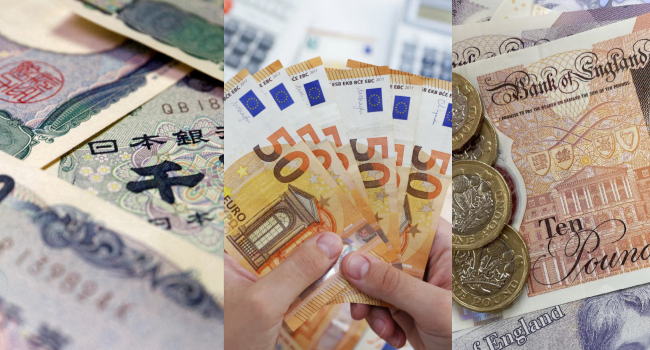
The yen surrendered part of its previous day’s gains on Thursday after the announcement of a ceasefire in the Middle East conflict, declining 0.15 per cent against the dollar to 158.81.
Data from money market broker Tokyo Tanshi showed that the overnight indexed swap market is now pricing in a 55 per cent chance of an interest rate increase at the Bank of Japan’s meeting later this month.

The euro slipped marginally by 0.01 per cent to $1.1661, while sterling edged up by 0.01 per cent to $1.3393.
Among major currencies, the US dollar has remained the biggest beneficiary of the conflict, partly because the United States is a net energy exporter and is less vulnerable to the economic impact of rising oil prices than import-dependent economies such as Japan and many European nations.
Investors continued to monitor the fragile ceasefire between the United States and Iran, amid uncertainty over whether it would hold.
The agreement appeared increasingly unstable as Israel pressed on with its parallel offensive against Hezbollah in Lebanon, while Tehran accused both Israel and the US of breaching the truce and declared that continuing peace negotiations would be “unreasonable.”
The Strait of Hormuz also remained closed to vessels without permits, although shipping operators indicated plans to resume passage before long, pushing oil prices upward.
US President Donald Trump stated that American ships, aircraft and military personnel would remain stationed in and around Iran until full compliance with the agreement is achieved.
The dollar index, which tracks the greenback against a basket of currencies including the yen and euro, remained unchanged at 99.07.
The five-week conflict has unsettled investor confidence and caused the largest disruption to global oil and gas supplies ever recorded.
Despite the truce, Iran now holds greater influence over shipping movements through the strategic Strait of Hormuz than it did before the war.
Analysts said strong US economic data could trigger renewed dollar strength. Akihiko Yokoo, senior analyst at Mitsubishi UFJ Bank, noted that positive US indicators may support a rebound in the greenback.
In Nigeria, the naira traded at 1,379.50 to the dollar on Thursday, slightly weaker than its opening level of 1,378.98, according to Nigerian Foreign Exchange Market data. Early trading remained moderate, with the day’s high reaching 1,380.00 before settling.
Elsewhere, the Australian dollar weakened by 0.06 per cent to $0.7039, while New Zealand’s kiwi gained 0.17 per cent to $0.5832.
In cryptocurrency markets, Bitcoin fell 0.49 per cent to $71,030.07, while Ethereum declined 1.06 per cent to $2,186.50.